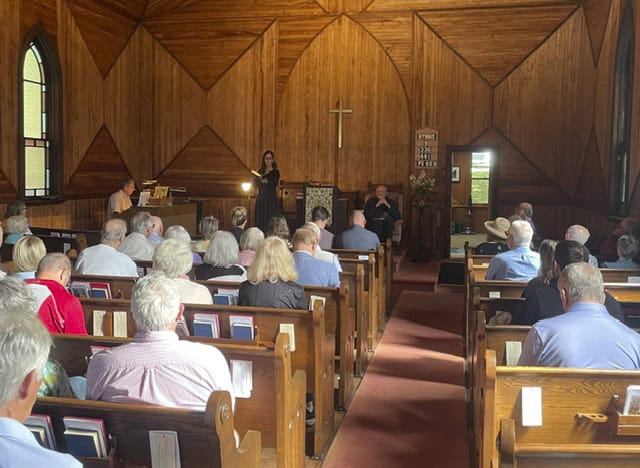
The sermon uses the healing of Naaman to show how God works through overlooked people and acts of love that cross boundaries. Although Naaman possesses military power and wealth, he depends on a captive Israelite girl, his wife and his servants to find healing. Their compassion and wisdom contrast with the fear, pride and assumptions of the powerful.
These “conspiracies of love” recur throughout Scripture and continue today. Rev. Farris illustrates this through his visit to Save a Child’s Heart, where Israeli medical staff care for children from communities divided by conflict. Such kindness does not resolve every injustice, but it saves lives and makes Christ’s presence tangible.
Naaman nearly rejects healing because his pride is wounded, yet his servants persuade him to accept Elisha’s simple instructions. His foolishness invites self-examination rather than contempt: all of us behave foolishly, and God loves us nonetheless. Human dignity rests on that love, not on rank or achievement. The sermon calls listeners to join practical works of compassion and ends with a hope that captives and displaced people may return home in peace.
This is not one of the best-known stories of the Old Testament. Noah’s Ark, Moses and the bullrushes, or David and Goliath fill that Bill. But the healing of Naaman? My children had Noah’s Ark toys and even bedsheets when they were little but no one is going to get rich making “healing of Naaman” products. But Jesus mentioned this passage in his first ever sermon in his hometown synagogue so maybe we should pay attention also. What was read to you this morning is only the first half of the story. Read the rest of it sometime. It’s interesting. And maybe, it may even have some echoes of contemporary reality in Israel and the Middle East.
The story is part of the grand history of Israel that fills the middle part of the Old Testament. That history was written after Jerusalem had been destroyed and many inhabitants had been taken captive and exiled to far-off Babylon. “By the waters of Babylon there we sat down and wept when we remembered Zion.” So goes one of their Psalms. The story is told for exiles, for victims of violence, for the down and out. Maybe we might recognize characters who fit those categories. Maybe the story might be interesting in light of events i today’s Middle East.
Over the years, I have taught my students when reading stories from the Bible, to identify the persons or groups in the text and to ask how we are like or unlike them. Or to put it a slight different way, are there characters we recognize? Let’s try that.
In a way, this story is like Downton Abbey. There are the rich and powerful, the VIPs, upstairs, and downstairs there are the servants, or to be a little bit more blunt about it, the slaves. Now, it’s easy to assume that the upstairs people are the ones that matter. The big shots, the king of Syria, the king of Israel, and Naaman the great general are the ones that matter. On the other hand, the servants, the slaves, in that society, they don’t matter very much at all. Or so it might seem.
The main character, of course, is Naaman. Naaman’s a general, the commander-in-chief of the Army of Syria, a real success story. I suppose the most successful general in the Middle East in recent years was probably General Stormin’ Norman Schwarzkopf. Naaman was the Stormin’ Norman of his time. But he has leprosy, a dreaded skin disease feared by all the people of the Middle East. Naaman can command the Army, but he can’t command his own health.
Still, Naaman is of great value to his master, the king of Syria, big shot number two. You can tell from the amount of money the king is willing to pay if only someone is able to heal his servant, his general. He supplies Naaman with “10 talents of silver, 6000 shekels of gold and 10 sets of clothing.” The last bit is a little strange, I admit. I think the translation of all that would be a “gazillion”. And money matters, then and now. It gets things done. The king writes a letter to the king of Israel ‘With this letter I’m sending my servant Naaman to you so that you may cure him of his leprosy”.
Now, here’s the third big shot, the king of Israel. But the king of Israel is not a big enough shot to cure leprosy. The king of Israel is shocked and complains,” Cure him of his leprosy! Am I God? Can I kill and bring back to life? Why does this fellow send someone to me to be cured of leprosy?” And he thinks that the king of Syria (to be fair the king of Syria really is his enemy) is picking a quarrel readying a cause for an invasion.
At the other end of the social scale, there is a servant girl, a slave who has been kidnapped from Israel during one of Naaman’s successful raids. She is young; she is powerless; she is far from home. One might think that she would be filled with anger and resentment but strangely enough, that does not appear to be the case. She speaks with her mistress, Naaman’s wife, “if only my master would see the prophet who’s in Samaria he would cure him of his leprosy.” Samaria is in enemy country. It is the capital of the enemy of Syria, the land of Israel. The prophet is named Elisha. The young girl is been kidnapped but she hasn’t forgotten her homeland, nor the God of her homeland. It’s easy enough to ignore the servants in the background of stories but this one will not let that happen. Nor will Naaman’s wife. The two engage in what might be called a conspiracy, a conspiracy of those with little power, a conspiracy for good.
It is doubtless Naaman’s wife who tells Naaman what the servant has said. And Naaman listens. Perhaps Naaman is simply so desperate that he will seize any chance to get well. But he listens…
So he informs the king of this prophet in Israel, this Elisha. The king of Syria doesn’t even know Elisha’s name. But he is not the only one who does not know the prophet. Under pressure, the king of Israel forgets that Elisha even exists. He has to be reminded himself of what God has done through Elisha.
By contrast the servant girl and her mistress, Naaman’s wife, get together to help Naaman. The one who remembers Elisha and more importantly, the God whom Elisha serves, is not a king, but the young slave girl. She has faith that God can act through Elisha to heal.
It’s interesting that there are a number of these conspiracies of women in the Bible. That story of baby Moses and the bulrushes, for example. There is a conspiracy of woman to protect the infant Moses. Pharaoh, the ruler of Egypt, tries to do away with all the infant boys of his Hebrew slaves. But Moses sister, Moses’ mother and even Pharaoh’s daughter conspired together to save the baby’s life. Or in the New Testament, when the worst has happened and Jesus has been put to death on the cross and his disciples flee in fear, it is the woman who gathered together on a Sunday morning to care for his body and to perform the last acts of love. I imagine you can call that a conspiracy of women who love also. So in our story, these two women, one older, one very young, one with a place in society and one absolutely powerless, get together to act with love. I think there are still loving conspiracies I hope there are many in this group of Christians. If you find one, please join it.
As it happens a few years ago I visited Israel/Palestine, where the story took place so many centuries ago. Among other things our group was taken to trenches in the very northern tip of Israel, trenches overlooking what else but Syria. And I thought of all the soldiers through the centuries that had stood at fortifications looking out for the enemy approach. After millennia there is still raiding and violence… A distressing thought.
But I do know that there are some conspiracies going on right now in the Middle East, the right kind of conspiracies. I know because I visited one. I visited a program called “Save a child’s heart” based in a hospital on the outskirts of Tel Aviv. Israel has a very advanced medical system compared to its neighbours and to the West Bank, which it controls. There is an historic enmity between those regions and Israel and I don’t need to tell you about the resulting conflicts and violence. But in the midst of all that discord, Save a Child’s heart provides the highest quality care and complex surgery for children with serious heart disease, from the West Bank, Arab neighbours and from Africa. They also train medical doctors from the region to diagnose serious cardiac problems.
Does this solve the many problems and ills of that part of the world? Of course not! But it is a beginning and it saves precious lives.
In the ward there was a mother, from the West Bank, whose child had just undergone surgery to correct the connection of the great vessels of the heart to the heart itself. She had the calm beauty of a Madonna painted by a Renaissance master. The Israeli nurses cared for both her and her child. They also translated for me, not hiding the troubles of the region.
“Tell him how long it takes to get here from your home,” A nurse said.
“Four hours,” the mother replied.
“And to return home?”
“Forty five minutes”
I asked the obvious question, “Why the difference?” (Everything is very close together by Canadian standards after all.)
The Israeli nurse, not sugarcoating the issue explained, “Getting through the border fence.” But in that ward, united by love for a precious child, no fence divided these women. Love and care ruled.
Th nurses had time to speak to me because they had prepared for a surgery for a child who had not yet arrived at the hospital.
“We are waiting for a child from Bethlehem,” the nurse said.
“Aren’t we all,” I thought to myself.
But in the peace of that room the Child from Bethlehem already had come.
That is a conspiracy of love. If you come across such a conspiracy, please join up.
But back to our story. Naaman shows up at Elisha’s home with the ancient equivalent of a motorcade, with horses and chariots and his servants and he stopped at the door of Elisha’s house. Think of a Mercedes stretch limo with motorcycle outriders and armed guards. That’s the modern equivalent. Now this really ought to impress Elisha! But Elisha doesn’t even come to the door. Elisha just sent a messenger to Naaman “Go wash yourself seven times in the Jordan, and your flesh will be restored and you will be cleansed.”
And Naaman is furious! He gets mad and engages in a little nationalistic rant. “I thought the prophet would come out and wave his hand over the spot and heal me of my leprosy. Are not Abana and Pharpar, the rivers of Damascus, better than all the waters of Israel? Couldn’t I wash in them and be cleansed? So he turned and he went off in a rage. I suspect that behind all this there is anger that Elisha doesn’t treat him with respect that he thinks he deserves. In their society and in ours, important people should be treated with great respect; they matter in a way that others do not matter. They are VIPs! They ought to be treated as such! But what do you want to know the truth as far as I can see it? I think Naaman is not only a successful general but also a bit of an idiot. In fact, at one time I thought I would make the title of this sermon,”A bit of an idiot!” But I thought of the wording on the church web page in the Internet, “Rev. Dr. Stephen Farris. A Bit of an Idiot”. I changed my mind on that one!
But really, even Naaman’s servants know better. They talk him down. “If he asked you to do something difficult, wouldn’t you do just that? Why not do this simple things he asks of you?” And they persuade him to act sensibly. By the way, later in the story and the part that we haven’t read this morning, there’s another episode like this where Naaman, healed of his leprosy, thinks that he needs mule loads of Israel Israelite dirt to take back home to his prayer room because he thinks that God’s power is shown on the soil rather than in changed lives. An important figure… But a bit of an idiot! An important person but…
Now, I suspect you’re probably thinking, “Hmmm,an important figure who is a bit of an idiot” but that is not where this sermon is going.
Neither Naaman nor the important figure we might have been thinking of is the only person who is bit of an idiot. I can’t call someone else a bit of an idiot as long as there is a functioning mirror in my house.
There would be something true about that hypothetical note on the web page . “Stephen Farris, A Bit of an idiot.” When you reach a certain age, my age for example, you spend a lot of time looking back on your life.I admit that when I look back at my life I frequently think with shame of the times when I’ve behaved like a bit of an idiot. I think the harm that people do to one another is often not caused by people who are villains, filled with evil plans. Trouble is often caused by people who are a bit of an idiot. Here’s the point: God loves even people who are a bit of an idiot. God saves them … and also those people whom we despise because they are a bit of an idiot. God loves them too. Maybe in a strange way, Naaman is right. He ought to be treated with respect. But because he is a general? No! But because God loves him and God’s prophet heals him.
Oh, one last thing. I hope that when Naaman got back home to Syria, he and his wife let the young girl go home. And equally I hope all the young girls and young women, all the old women, all the old men and all the young men will be free to go home in in peace in the time to come.