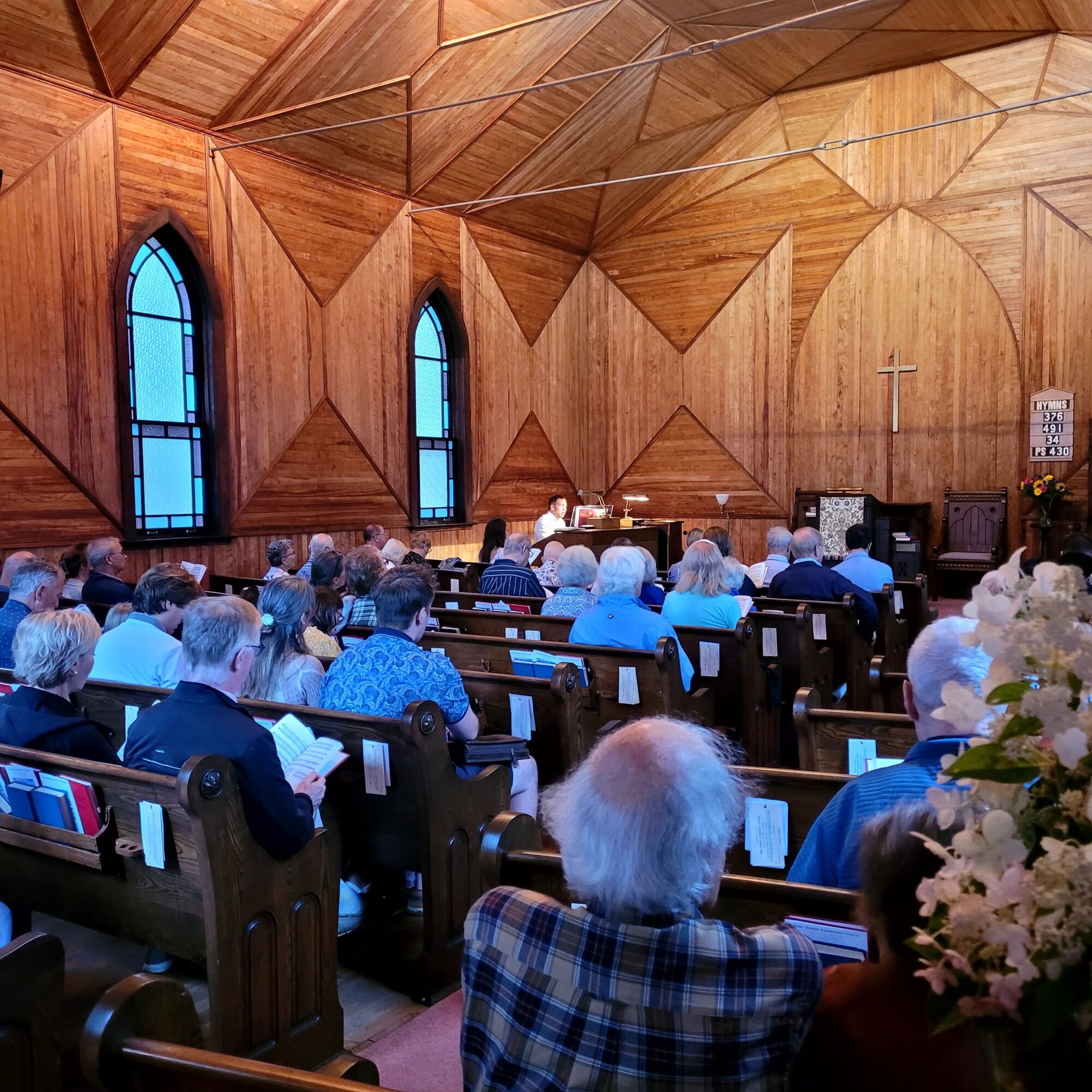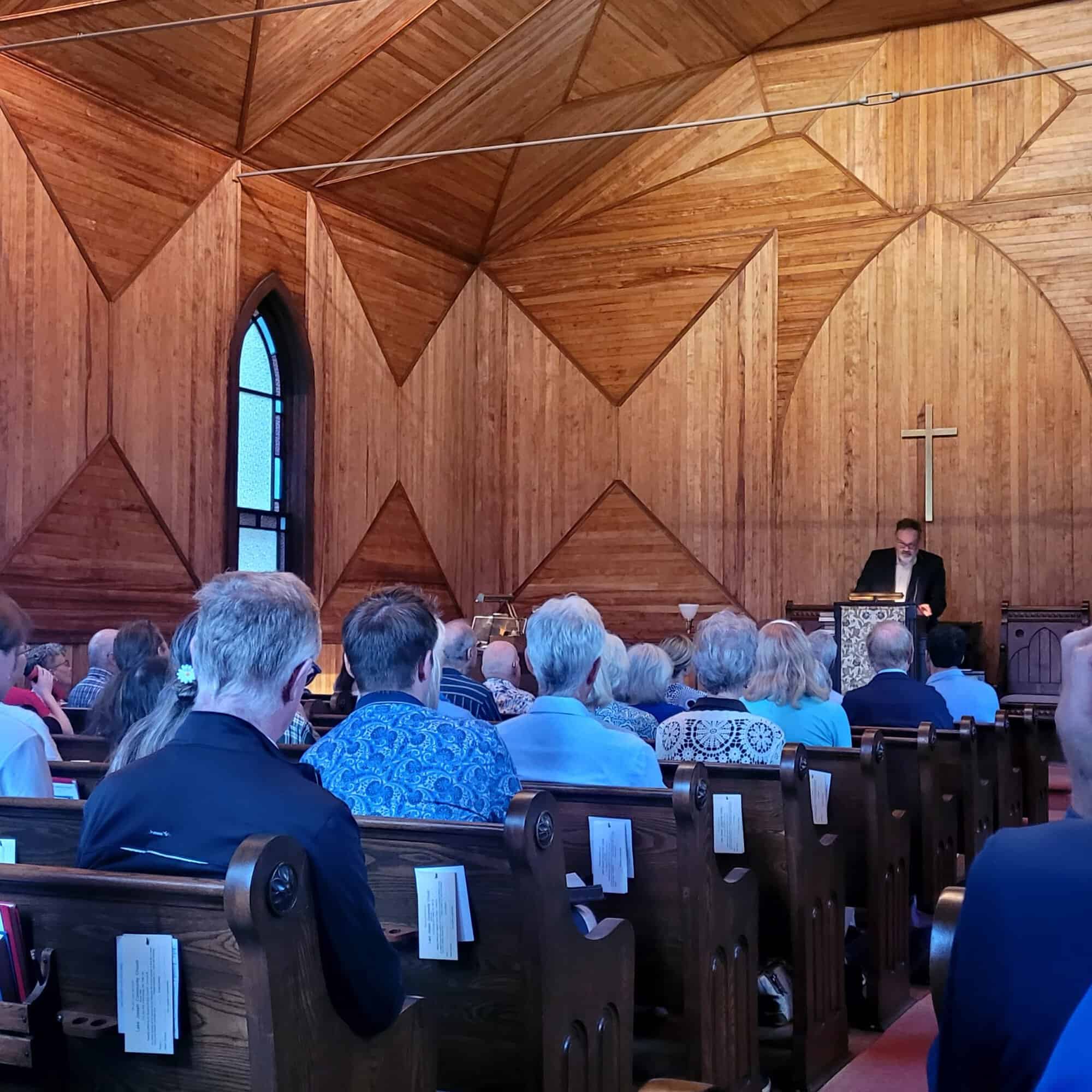
Rev. Jason Byassee’s sermon on Genesis 45 reflects on Joseph’s reunion with the brothers who had sold him into slavery. It argues that God works through imperfect people, painful experiences, and even human wrongdoing to preserve life and bring healing. Joseph’s family is profoundly flawed, yet God uses their brokenness as part of a larger story of rescue and reconciliation.
The sermon also explores what it means for Israel to be God’s chosen people. Chosenness is not a claim of superiority, but a calling to bless the world. Christians, therefore, should reject antisemitism and recognize that their faith is inseparable from Israel’s story and scripture.
At the heart of the sermon is Joseph’s refusal to seek revenge. Although his brothers intended him harm, Joseph recognizes that God has brought good from their actions, saving both his family and many others from famine. This pattern anticipates the Christian understanding of Jesus’ crucifixion: what appears to be defeat and suffering becomes a source of life, forgiveness, and reconciliation.
The sermon challenges the human tendency to define ourselves by excluding or blaming others. Joseph’s brothers make him a scapegoat, but Joseph ultimately offers them mercy instead of punishment. Likewise, Jesus enters into humanity’s cycle of scapegoating and violence, then breaks it through resurrection and forgiveness. The sermon’s central message is that God’s grace does not excuse evil, but it can transform even our deepest failures into opportunities for healing, renewed life, and service to others.
Genesis 45 Joseph could no longer control himself before all those who stood by him, and he cried out, “Send everyone away from me.” So no one stayed with him when Joseph made himself known to his brothers. 2 And he wept so loudly that the Egyptians heard it, and the household of Pharaoh heard it. 3 Joseph said to his brothers, “I am Joseph. Is my father still alive?” But his brothers could not answer him, so dismayed were they at his presence. 4 Then Joseph said to his brothers, “Come closer to me.” And they came closer. He said, “I am your brothers, Joseph, whom you sold into Egypt. 5 And now do not be distressed or angry with yourselves because you sold me here, for God sent me here before you to preserve life. 6 For the famine has been in the land these two years, and there are five more in which there will be neither plowing nor harvest. 7 God sent me before you to preserve for you a remnant on earth and to keep alive for you many survivors. 8 So it was not you who sent me here but God; he has made me a father to Pharaoh and lord of all his house and ruler over all the land of Egypt. 9 Hurry and go up to my father and say to him, ‘Thus says your son Joseph, God has made me lord of all Egypt; come down to me; do not delay. 10 You shall settle in the land of Goshen, and you shall be near me, you and your children and your children’s children, as well as your flocks, your herds, and all that you have. 11 I will provide for you there, since there are five more years of famine to come, so that you and your household and all that you have will not come to poverty.’ 12 And now your eyes and the eyes of my brother Benjamin see that it is my own mouth that speaks to you. 13 You must tell my father how greatly I am honored in Egypt and all that you have seen. Hurry and bring my father down here.” 14 Then he fell upon his brother Benjamin’s neck and wept, while Benjamin wept upon his neck. 15 And he kissed all his brothers and wept upon them, and after that his brothers talked with him.
Such a gift to be with you friends. I’ve heard about Muskoka since I arrived in Toronto and learned my fellow Americans are wrong about what to call deck chairs (Muskoka, not Adirondack). The way folks talk about Muskoka, you’d think it was heaven. They seem confused when I talk about some other heaven that’s better. Bill Smallman was my last combat veteran from World War II, he’s got a window here in this place, was proud of that. So glad to be with you here in person, thank you for the invitation.
Any baseball fans among us? Last summer was fun in Toronto wasn’t it? 20 odd years ago I was living in Chicago. I’d grown up an Atlanta Braves fan as all good southerners do and was happy to see that former Brave Jason Marquis had landed with the Cubs. The Cubs were a borderline playoff team in 2010. But Marquis assured his new teammates: I know we’ll make the playoffs. Because, he said, I’m the magical Jew. My teams always make the playoffs. Sure enough the Cubs did. Every team Marquis played for for ten seasons made the playoffs. He still has a major league record. He’s the magical Jew you see.
You can see the glory and the danger of claiming to be religiously special. Marquis was kidding (I think), he just had a lucky run. But being chosen as God’s people has often meant good things for Jewish people. It’s also meant virulent Anti-Semitism from ancient times to the Holocaust to today, including in Canada, where anti-Judaism has become almost socially acceptable. I work at a Chautauqua in northern Michigan in the summers, and we had a rabbi as a guest preacher a few weeks back. And since most Christians don’t talk faith with Jews very often, our questions weren’t very good. Why don’t you celebrate Christmas? Why don’t you think Jesus is messiah? Why can’t the state of Israel get along with its neighbours? All versions of this question: what’s wrong with you Jews? In the broadway musical Fiddler on the Roof the lead character Tevye says to God, if this is how you treat your chosen people, couldn’t you choose somebody else for a change?
You can see ancient Israel wrestling with these sorts of questions already in the bible. What does it mean to be chosen? Doesn’t that stoke resentment from those not-chosen? Can’t thinking you’re chosen make you arrogant, or even racist against other peoples? Most modern liberal and conservative Jews don’t talk much of chosenness anymore for precisely these reasons. It’s still mentioned in scripture and in the synagogue prayers, but nearly dropped from their present-day teaching and thinking. I remember telling a group of Jewish students how cool election is. Why? Because it means you’re God’s beloved, God’s bride, God’s child, God’s own people! I could see their whole demeanor slump. Ugh. No, thank you, you’re being very nice, but as soon as people talk like that, bad things happen to us. Maybe we can just be people, not special, just ordinary, does that work?
Joseph has no such scruples. He is a late-born long-awaited son for Jacob and his favourite wife Rachel. And he’s his daddy’s favourite. Jacob makes Joseph not a coat of many colours, as Broadway has it, but a coat with long sleeves. Sleeves down to the ground, a coat for someone who will never have to work with his hands. Joseph’s 11 brothers notice the favoritism. And hate it. And Joseph dreams. In one dream, he is a sheaf in the field, and 11 other sheaves bow down to him. Interesting, don’t you think, brothers? In another dream his star rises, and 11 other stars plus the sun and moon bow down to him. That includes his father Jacob and his dead mother Rachel. His brothers grumble. Who made you lord and ruler over us? The answer is God did. But Joseph might have kept those dreams to himself.
Joseph the dreamer. When Martin Luther King Jr. was assassinated in 1968, the text preached at his funeral was from the Joseph story. It’s a quote from the 11 brothers in Genesis 37: “come, let us kill him, and we will see what becomes of his dreams.” The brothers think murder will erase Joseph, but we’re still telling this story today 3000 years later. King’s murderers didn’t kill the dream of racial reconciliation either, did they? Violence only looks strong, it’s actually unimaginative and weak.
The brothers take Joseph, strip him of his notorious coat, and throw him in a pit to die. But then one says, you know we could make some money off him. So they plan to fish him out and sell him into slavery. They slaughter an animal and dip the coat in its blood and tell Jacob they’d found it. The old man thinks his favourite has been torn apart. And the eleven surviving brothers are rid of the nuisance. Or so they think.
And you thought your family was dysfunctional.
These twelve sons of Jacob are the forefathers of the twelve tribes of Israel, the family through which God is healing the world. Not was, is healing the world. If I were God, I’d have chosen a better family. A more exemplary one. More pious. But God seems to like to choose broken things through which to bring healing.
Walker Percy, 20th century novelist and philosopher, used to ask this question
Where are the Hittites? Why does no one find it remarkable that in most world cities today there are Jews but not one single Hittite, even though the Hittites had a great flourishing civilization while the Jews nearby were a weak and obscure people? When one meets a Jew in New York or New Orleans or Paris or Melbourne, it is remarkable that no one considers the event remarkable. What are they doing here? But it is even more remarkable to wonder, if there are Jews here, why are there not Hittites here? Where are the Hittites? Show me one Hittite in New York City.
And it’s not just that the Jews survive to today, amazing as that is. Jonathan Sacks, late chief rabbi of Great Britain, used to point this out. Every great empire in the west has tried to exterminate Jews. From ancient Egyptians, Babylonians, Greeks, Romans, medieval Christians, Nazis and Soviets all wanted Jews gone. Why? Jewishness signifies difference. Jews follow different laws, eat differently, marry differently. Not better or worse, just different. But empires hate difference. Guess what all those empires have in common? They’re all gone. Who’s still there? The Jewish people.
Joseph is sold to Potipher in Egypt, the captain of the guard. Who immediately trusts Joseph. Puts him in charge of his whole house. Joseph is the magical Jew. Except Potiphar’s wife has an eye on the young man, who won’t give in, so she claims falsely that he tried to rape her. And she plays the race card. “My husband has brought among us a Hebrew to insult us! He came in to lie with me, and I cried out” (Gen. 39:14). This opens a question: are the Jewish people a race, or a religion, or something else? They’ve often been seen as a race by outsiders. Nazi doctors used junk science to speak of eliminating a threatening strain in humanity. But it’s not so. Jews are first a family. All the descendants of Abraham and Sarah. A friend of mine is a 16th generation rabbi, back to the 1400s in what’s now Lithuania. Now his daughter is in rabbinical school, so make that 17 generations. But 700 years is nothing if you can trace your lineage to Abraham. So Judaism is a family, not a race. But you can also convert to Judaism. So it’s not a closed family, it’s an open one that takes in adoptions. Joseph himself marries an Egyptian, his sons Ephraim and Manassah are grandsons of an Egyptian pagan priest, and they have two of the twelve tribes of Israel named for them. There is no Israel without the nations, because Israel only exists to bless all the other nations.
Joseph has a sort of natural buoyancy to his career. Everywhere he goes, he rises. He’s in a pit? He’s fished out. Sold into slavery? He becomes master of the house. In jail on a false charge? He earns the trust of the jailer and runs the prison. And he can interpret dreams. So Pharoah throws some servants in jail, they dream, and Joseph tells what they mean. Word gets back to Pharaoh there’s a dream interpreter in prison. Pharaoh says he dreams of seven fat cows, then seven scrawny ones coming out of the Nile, and the scrawny ones eat the fat ones. Joseph says here’s what God is saying. Notice: God can speak to foreigners, non-Israelites, even Pharaoh. There will be seven years of plenty and then seven years of famine. So store up grain for the years of famine. Pharaoh does. And makes Joseph his viceroy in Egypt. Joseph gathers grain, stores it, and then the hungry world trudges to Egypt for food. His murdering, slaving brothers also turn up to beg. They don’t recognize him. Why would they? They think Joseph is dead. Not the ruler of all Egypt, with their fate in his hands.
Joseph’s betraying brothers are in his grip. All he has to do is squeeze. Instead, he opens his hand and sets them free. Come live here like kings. Bring our father Jacob. Tell him his son lives, and in fact will save the whole family. Joseph’s words of mercy:
Do not be distressed or angry with yourselves because you sold me here, for God sent me before you to preserve life. . . So it was not you who sent me here but God; he has made me a father to Pharaoh and lord of all his house and ruler over all the land of Egypt.
Remember that terrible thing you did? Selling me, lying to our father? Actually God did that to save your lives. And really to save the world. When Jacob gets to Egypt he blesses Pharaoh himself. Pharaoh, the most hated person in all scripture, receives a blessing from Jacob, one of the original patriarchs. Where do you think Jesus learned about loving enemies? Israel’s calling is to bless all creation. No Israel, no blessing, no creation.
Why am I going on about this? How is this not a lecture on the excellence of Jewishness? Well, this is our Christian bible, its anchor book Genesis, and its most important story. Creation gets two chapters in Genesis. The sons of Jacob get 22. This story shows how the people Israel come to be. What looks like devastation is actually salvation, not just for Joseph but for the whole people. Anybody recognize that pattern? What looks like the worst—Jesus’ crucifixion—is actually life for the world. Where do you think Jesus learned that story? From here, in Genesis, as Mary cooed to him the songs and sighs of Israel. You can have Genesis without Jesus. That makes you Jewish. But you can’t have Jesus without Genesis. In fact, the more we love Israel and her scripture the more we’ll love the Jew Jesus. And the rest of his Jewish family.
The church has often criticized or even attacked our Jewish forebears. You have Genesis, why can’t you see Jesus there? St. Paul has the best answer. He compares Israel to a great tree, massive roots. Like an old growth tree somewhere the loggers never got to. At Cathedral Grove on Vancouver Island some of those cedars are 600 years old. The root systems when they fall are like jungle gyms, 50 feet in diameter. For Paul, Israel is the tree, the roots, the trunk. We gentile Christians, non-Jews, are like branches from some other tree grafted in by faith and baptism. We’re not the trunk. Israel is. We draw sustenance and nutrients from those roots, not the reverse. Another good answer: Franz Rosensweig was a mid 20th century Jewish philosopher who was interested in Christianity, did not convert. But he said Judaism is the star of David, it’s the molten core of God’s love. Christianity is like the rays emanating from that star, bringing light to the world.
There’s something here about evil too. The brothers mercilessly sold their brother and lied to their father. But Joseph says God used that to save them and the Jewish people and the world. Evil thinks it’s strong, powerful. One Christian says if you grab the devil by the scruff of the neck . . . Some faiths have good and evil as two opposing forces, yin and yang, not clear who’ll win. Like the force and the dark side. Not Christianity. Evil has no proper substance in Christian faith. And yet God can use even it, nothing as it is, to bring good. Later Joseph tells his brothers “Even though you intended to do harm to me, God intended it for good, in order to preserve a numerous people.” What if God can even use the worst thing you ever did to bring life to you and others?
A friend of mine grew up in a conservative Christian household, a pastor’s daughter. And she found herself pregnant as a teenager. All her hopes for the future on hold: scholarship, esteem in community and church, the works. She had that child and gave her up for adoption and went back to her life. Years later mother and daughter found one another again. My friend had become a pastor, married, and birthed and adopted more children. Her first birth daughter is also a Joseph like annoying do gooder, devoting her life to helping disadvantaged people. My friend said this thing that so matches the Joseph story, she said this: what was my greatest shame has become my greatest joy (repeat).
But Joseph is not above criticism here. Remember how later the Jews will be slaves in Egypt? Ten plagues, Passover, Exodus all that? That starts here with Joseph. Joseph runs Egypt so efficiently that it becomes the world’s great slaving power. Joseph fills barns with grain in the fat years, so when people come and buy, then beg, in the lean years, Joseph turns them into slaves. Takes their land. Makes them subject to Pharaoh. The bible never spares criticism from God’s own people. In fact, to be God’s people opens you to more scrutiny. The logic of empire is that you take people’s money, people’s freedom, people’s souls if you can. The logic of chosenness is you repent. Because there is a good God who forgives.
I mentioned Rabbi Sacks before, of blessed memory. He summarizes Judaism this way: the only God there is intervenes in history personally to free slaves. That’s good right? We Christians narrate Judaism this way. First God gives humanity one rule. Adam and Eve break it and we break God’s heart. Then God says ok I’m going to wipe out all the bad people and keep the one good family, Noah’s. Flood, animals two by two on the ark, all that, and then ten minutes after the flood, Noah is drunk naked and cursing his own children. Well that didn’t work out. So God says I’m going to send a family. Not the best family, maybe the worst. To bless the world through that family. It’s hard on the family. Nobody likes a teacher’s pet. But that they persist to this day shows God’s goodness. And finally God says ok, if nobody can be human the way I want, I’m going to have to do it myself. And God comes among us as a Jew, as a human being, to show us how to be Israel, how to be human.
One of my favourite ways for us Christians to understand salvation comes from this story. It has to do with scapegoating. Ever notice how we human beings know who we are by ganging up and excluding someone? This isn’t just kids on the playground being mean. It’s baked into human psychology somehow. It’s especially apparent in American politics. The Muslim bogeyman is back on the American campaign trail just as Muslim-Americans are getting nominated to higher office. But we all do this. Canadians scapegoat Americans. Liberals do conservatives and vice-versa. Well. In this story Joseph is the scapegoat. The brothers know who they are by jointly eliminating him. Then it turns out the one they’ve eliminated has power over them. The one they tried to destroy can now destroy them. He doesn’t. He offers them life, health and peace instead. Similarly in Jesus Christ God himself enters into our human scapegoating mechanism as the scapegoat. To break our scapegoating. The world’s greatest religion, Judaism, and greatest political system, Rome, team up and destroy him. And he comes back not with vengeance but with forgiveness. Now humanity is invited to know who we are not by who we scapegoat and exclude, but by baptism and faith in the risen one. Next time you have a chance to join in a group denouncing someone else’s identity, you can say sorry, I only know who I am because of a resurrected rabbi.
I keep thinking about Joseph’s brothers. They’re not all alike. Some are especially shameless. Simeon and Levi are called out for being violent. Judah is, traditionally, the one the messiah will come from. Joseph’s descendants are from his Egyptian sons Ephraim and Manasseh. Most are long gone. The ten northern tribes of Israel were defeated by the Assyrians in 722 BC and never heard from again (unless you believe myths that the Brits are a lost tribe. Or the Mormons. Or indigenous Americans). Only Judah and Benjamin survive. Jews are called Jews today because of the tribe of Judah that most come from. The brothers do improve morally. When they have a chance to give up their brother Benjamin to save their skin, they don’t. Joseph plants a treasure in Benjamin’s belongings so he’ll be caught for theft. His brothers have a second chance. This time, they refuse to head home without their father’s favourite. They’ve learned the first lesson of the bible. Cain once challenged God, “am I my brother’s keeper?” These brothers show they have learned how to be brothers rightly. And notice this: they’re saved not by anything they do. Not even with their moral improvement. They’re saved through the worst thing they ever did. Most people think faith works like this: do good get rewarded; do bad get zapped. The Joseph story says this: God can use the worst to bring about the best, for us and others. And we might not even recognize it.
That’s the God of Joseph, of Israel, at work. Amen.