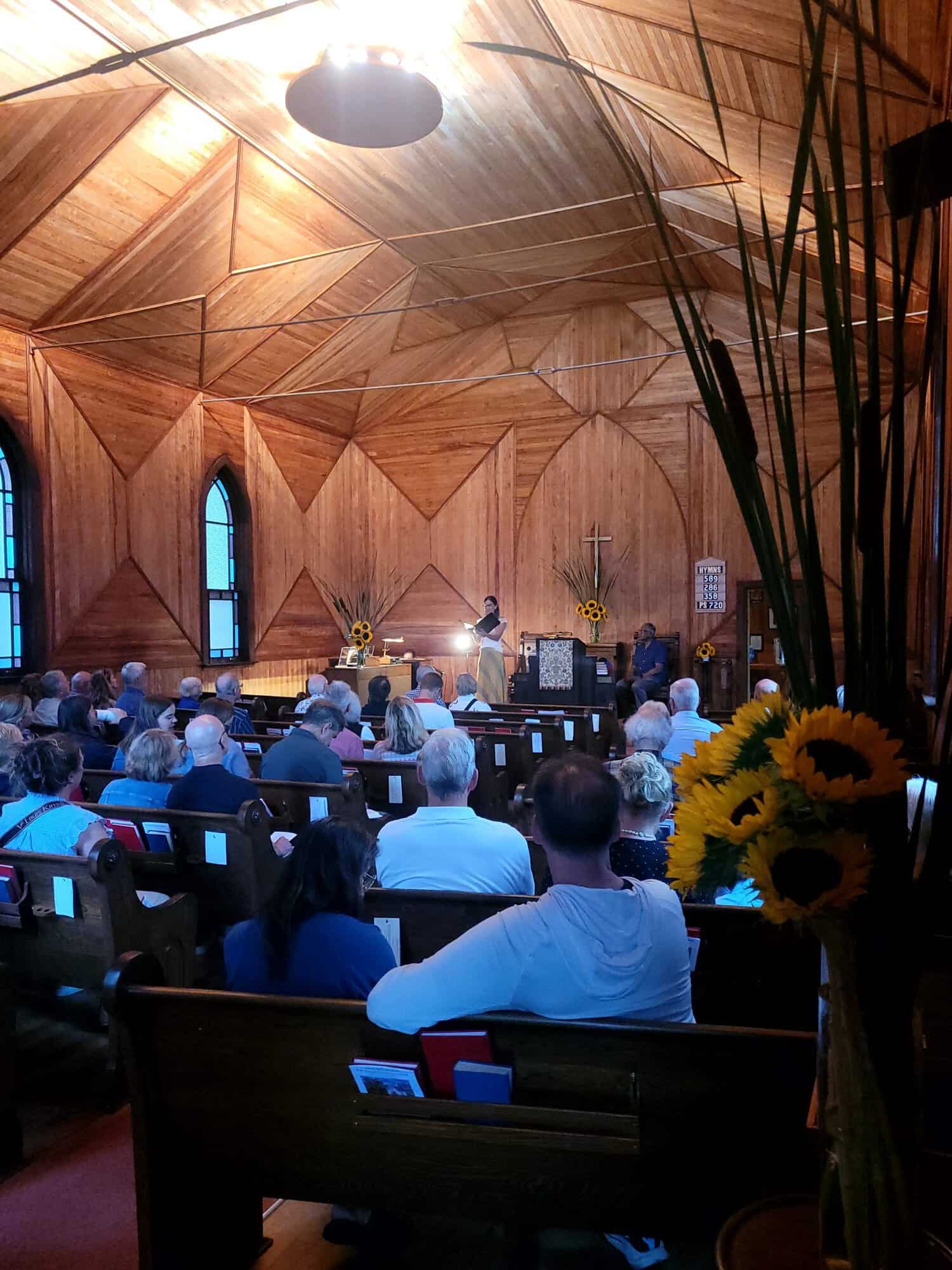
The sermon encourages listeners to accept aging with grace rather than resentment, to remain active in faith and relationships, and to focus on what truly matters instead of dwelling on lost youth or physical limitations. Rev. Dr. Sydney reminds believers that their identity and worth are rooted in God’s love, not in their age or abilities. He concludes that aging well means growing in character, serving others, and trusting God’s presence and promises until the end of life’s journey.
A little boy once asked an elderly woman in a wheelchair how old she was. She smiled and answered, “Thirty-nine and holding.” He looked at her and said, “Well, how old would you be if you let go?”
Next to dying, the recognition that we are aging is, for many, the most profound shock of our lifetime. Some men, more than women, live in denial that they are getting any older.
We are sensitive about age. We have an ambivalence about aging. Everybody wants to live long; nobody wants to grow old. But as someone said, “Aging seems to be the only available way to live a long life.” Yet aging has its challenges. You’ve heard these clever lines and many more:
You know you’re growing old when:
your knees buckle and your belt won’t.
It takes two tries to get out of the couch.
It takes twice as long to look half as good.
Everything hurts, and what doesn’t hurt doesn’t work.
I was speaking to one of my favourite preachers, William Willimon when I heard him at a preaching festival in Toronto. He said, in his own matchless way, “I took Gingko capsules for a time last year. Gingko is alleged to help retard memory loss. I stopped when I realized I had forgotten to take the capsules for nearly a week.”
With age comes sickness and weakness, loss, forgetfulness, dependence, and incontinence. I grieved over the effects of TIAs on my dad as he wasted away to a shadow of the strong and vibrant man, he had been. No wonder the often-gloomy writer of Ecclesiastes (11:8–10) tells us to enjoy life while we are young, because dark days are ahead.
Paul himself does not deny the effects of aging. He says that outwardly we are wasting away. We may become physically weaker, but that does not signal the end of ambition, initiative, passion, productivity, or the possibility of starting fresh. Think of Abraham, setting out from Ur of the Chaldees at seventy-five. Moses was eighty when he led the people out of Egypt. Deuteronomy tells us that he was one hundred and twenty when he died. His vision was unimpaired, and his vigour had not abated. Then there was Caleb, at eighty-five, standing at the edge of the Promised Land, crying out, “Give me this mountain.”
However, there are days when our ordinary, everyday reasonable challenges are mountain enough. We would like financial security. We want to remain healthy and active as long as possible. We would like to be self-actualized or have ego integrity rather than despair, and generativity. We would like to remain obedient and faithful to the end. We want to be able to look back with gratitude.
Moses was looking back as he wrote this psalm, thankful for God’s timeless grace and mercy. His was quite a story. Adrift in the Nile in a basket, rescued by a princess, then leading his people across the lifeless Sinai desert, he trusted that God would provide, as indeed God did in remarkable ways. After forty years of wandering in the wilderness, they stood on the edge of the beautiful Jordan, and Moses wrote:
Lord, you have been our dwelling place in all generations.
Before the mountains were brought forth,
or ever you had formed the earth and the world,
from everlasting to everlasting,
you are God.
I shared those verses with an elderly woman who had spent a lifetime in Christian service. She told me that her daughter, now in her mid-sixties, had just been diagnosed with Stage 4 pancreatic cancer. As she brushed away her tears, we acknowledged that in good times and in bad, God walks with us through our greatest joys and our deepest hurts and disappointments.
I hope that has been your experience. I have known people—clergy included—who have become embittered and angry. God, they feel, has let them down. Churches have failed them. Doors of opportunity have been slammed shut in their faces. There are regrets and mistakes from which they have never been able to recover. But I hope that getting older means becoming a little wiser, with the gift of perspective. As Ingrid Bergman once said, “Getting old is like climbing a mountain; you get a little out of breath, but the view is much better.”
It is never too late to choose what is important for your life and for the happiness of others, because life is exceedingly short, frail, tenuous, and as brief as a shooting star.
The psalmist says of our days on earth:
You sweep them away; they are like a dream,
like grass that is renewed in the morning;
in the morning it flourishes and is renewed;
in the evening it fades and withers.
Have you ever sat beside someone who was dying, whose laboured breathing finally ended in an eerie silence? The aging patriarch writes, “Our years come to an end like a sigh.” And by God’s grace, we hope it is a peaceful sigh. As an old man, the Apostle Paul wrote to the Philippian church, “I have learned in whatever state I am, to be content. Would that not be a wonderful state of your mind and spirit?
Aging involves many losses: health, independence, careers, dreams, and loved ones.
And here is the advice of the psalmist, “So teach us to count our days that we may gain a wise heart.” What does that mean?
Perhaps some of you have read Margaret Craven’s I Heard the Owl Call My Name, which one reviewer described as “rare and beautiful… you’ll never be the same again.”
Mark, the young priest serving a First Nations community in northern British Columbia, has a fatal illness, and his life is slowly ebbing away. One day, the owl will call his name, which in Indigenous tradition means that death is near. His supervisor, the bishop, comes to visit him. As they ride together in a boat, the bishop asks for the motor to be shut off in the middle of a large inlet. “The bishop said, ‘Let us not hurry. I seldom have a few hours to myself.’ And then he added, ‘It is in these quiet hours that I have time to reflect on the fundamentals, what really counts, what I deeply believe, and what I must give myself to, so that when the time comes, I am ready to die.'”
The primary question for us as Christians, is not, “How can I stay young?” The deeper question is, “How can I continue to grow into the fullness of Christ at every stage of life?”
May I make some suggestions?
At every stage of life, value community.
You are mostly church people, so I can say this without hesitation: cherish your church community. It will be good for your health, and for the health of your church. There was a time when people crowded into churches to hear great preaching. Today, anyone can access an endless library of world-class sermons. You know what is truly scarce today? Community. And you know this as well: people who have a community of friends generally do better through life.
I am deeply grateful for the gift of my small group/cell group at church. I remember when my wife Angela suffered her brain aneurysm, a subarachnoid haemorrhage, a form of stroke, fourteen years ago. The neurosurgeon met me in the hallway and said, “We are fighting for her life.” I didn’t believe it. But as the reality slowly sank in, and my hands grew cold with anxiety, I knew that our small group, the cell group to which we belonged, had cancelled everything that afternoon to go to God in prayer. I received support for my daily trips to Hamilton General Hospital. Meals appeared at my door. One day we received a beautiful bouquet of origami flowers and cranes. Each day we opened one, because every flower contained a handwritten promise of God’s love, grace, and faithfulness. That is what Christian community looks like.
What else can you do as you age?
Take time to deepen your connection with God.
Cultivate the spiritual practices that sustain the soul. Pray. Reflect. Sit quietly in God’s presence. Breathe deeply the message of God’s unfailing and unconditional love. Be confident of Christ and let him colour your world.
CS. Lewis said in a lecture at the Socratic Club at Oxford, “I believe in Christianity as I believe that the sun has risen: not only because I see it, but because by it I see everything else.” With Christ at the centre, you begin to see everything differently. Human beings are no longer simply other life forms with varying degrees of genetic closeness. They are not obstacles to your happiness, nor merely people whose rights must be acknowledged. They are flesh-and-blood people whom God loves, just as God loves you. Every life matters because every person is made in the image of God. What would it mean if Christ truly became the centre, the hub around which everything else in life revolves?
Perhaps it would mean giving yourself more completely to becoming the love of which Jesus spoke. Do you know what the earliest Christians were called? They were simply known as “Followers of the Way.” They followed the way of Jesus. What does that mean for us? Let Jesus be your hero, your model, and your guide for living. Listen for his voice in your heart and then obey.
Many people become either more fearful or more compassionate as they grow older. Perhaps the purpose of aging is not simply accumulating years, but becoming increasingly like Christ: kinder, gentler, less judgmental, more forgiving, walking with grace and compassion.
Years ago, in Macon, Georgia, there was an award presented to a group that had accomplished something innovative and outstanding. That particular year, the award went to the Community of the Exceptionals – “exceptionals” being people living with a variety of physical and developmental challenges. The award ceremony was held in a large auditorium packed with several thousand people. Among the special guests were Jimmy Carter and Rosalynn Carter. It was a very significant occasion. At the front of the auditorium was a simple church setting, complete with candles to be lit.
The young man chosen to light the candles had a condition that made control of his hands and legs extremely difficult. Slowly he made his way forward. His thin, trembling legs barely supported him, while the hand holding the taper shook and waved uncontrollably. No one laughed. No one mocked. The entire audience watched in anxious silence. Jimmy Carter leaned forward in his chair. The person sitting beside him later said they heard Carter quietly whisper, “O Lord, please help that poor boy light that candle.” Fortunately, the young man succeeded. The candle was lit. A collective sigh of relief filled the auditorium.
Right from the start of his presidency, Jimmy Carter made it clear he was a follower of Christ, and it would become increasingly evident he had a heart that was tender and compassionate. Not long after leaving the White House, he devoted himself to Habitat for Humanity, helping provide affordable housing for families around the world.
I hope that as the years pass, you may be able to say, “The goal of my life isn’t simply to grow older, but to grow larger in love.” Will that be your legacy? Jesus spoke of an immense tree that begins as a tiny mustard seed. It grows ever upward, reaching for the sky until it becomes a great tree. Animals find shade beneath its branches in the heat of the day, and birds build their nests in its branches. The point is not that the tree is large. The lesson is that it has become a blessing to everything around it.
Eugene Peterson, in The Message, retells the parable in a North American setting:
“How can we picture God’s kingdom? What kind of story can we use? It’s like a pine nut. When it lands on the ground it is quite small as seeds go, yet once it is planted it grows into a huge pine tree with thick branches. Eagles nest in it.”
As the years pass, may your heart become softer rather than harder, more generous rather than more fearful, more gracious rather than more demanding. May people discover in your presence something of the gentleness of Christ. May they find shade beneath the branches of your life. May your legacy not simply be that you lived a long time, but that you became a blessing.