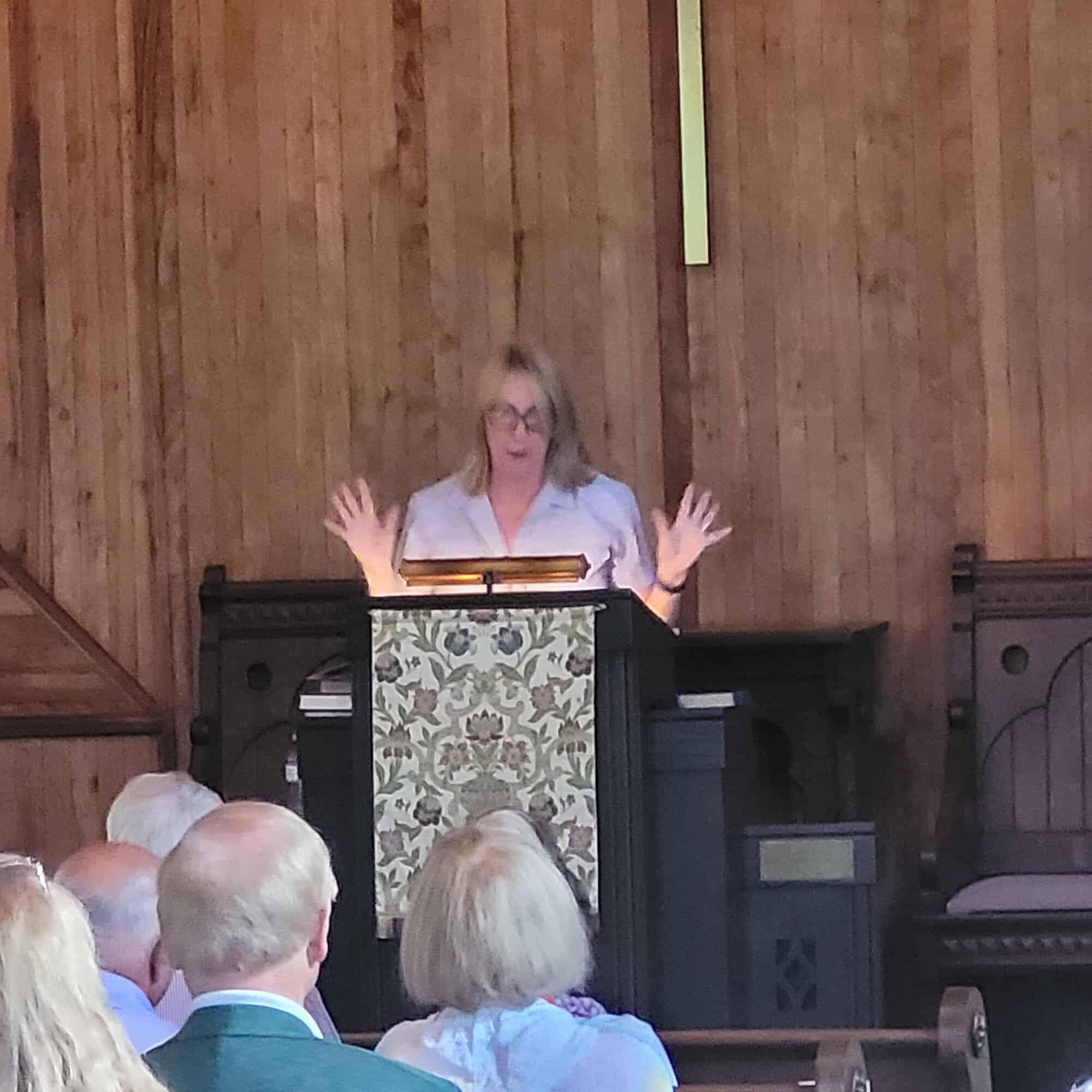
“Wonderfully Made” presents the human body as a good and sacred gift from God. Drawing on Psalm 139 and 1 Corinthians 6, Lori Diaz rejects both body-worship and body-neglect, arguing that Christians should care for their bodies as temples of the Holy Spirit and as part of their stewardship of God’s creation.
The sermon emphasizes that health is not about meeting an ideal appearance or ability standard. Each person has different limits, illnesses, disabilities, and stages of life, yet every body is made in God’s image and has value and purpose. Nourishing food, rest, movement, disciplined habits, and gratitude can therefore be acts of worship, enabling people to serve God more fully.
Diaz concludes by encouraging listeners to focus on what their bodies can do rather than comparing themselves with others, and to pursue healthy living in supportive community.
Scriptures: Psalm 139 and 1 Corinthians 6:12-15a &19-20
In the Judeo-Christian tradition of which we’re a part, believers have acknowledged for thousands of years that human beings owe our existence to the creative work of God. Whether you ascribe to a literal reading of the book of Genesis, or whether you perceive a consistency between modern scientific discoveries and biblical truth, that’s not a rabbit hole I’m going down this morning: I think we can all agree that, either way, human beings are part of God’s amazing creation. Some would say we’re “the crowning achievement of God’s creation.” Not only that, but we’re also the only creatures said to be made in God’s own image. We’re creatures, not gods, but we’re made in God’s image, which means that our existence is both material (like other creatures) and spiritual (like God).
Our bodies are part of God’s Creation and as God called human beings to care for creation – to be the stewards of God’s creation – part of that is to care for these bodies that we have been given. Our bodies are a gift from God, given to us for a holy purpose (otherwise, we’d be wholly spiritual beings, like the angels). God has also made sure we have everything we need to care for our bodies: food, water, breath, movement, shelter, etc.
Like many of you, I’m sure, I have, in my life, sometimes been good at this and sometimes not been good at this! I’ve long had an interest in reading and learning about nutrition and fitness, though not always the time to put it all into practice; but this interest that I have is partly based on an understanding of health and wellness as stewardship of God’s creation; and this is a biblical view, as we see from what Paul wrote to the Corinthians.
In some circles, Christianity has rejected the idea of taking care of the body as vanity – and in some other circles it has certainly become that, where people become obsessed more with appearance or with certain achievements than with health and wellness. Christian thinking can fall into a kind of “dualism,” – the spirit is good & the body is bad, with all the appetites – such as greed, hunger and lust – that it represents.
If, as Christians, we believe in the incarnation, which is the true focus of our Christmas celebrations – if we believe that God became a flesh and blood human being in Jesus, that the Word became flesh and dwelt among us; and if we believe what we celebrate at Easter – that God raised Jesus’s body from the dead – then we cannot believe that the physical world and our physical bodies are unimportant to God. It’s important for us, as Christians, to take a godly view of the human body, to avoid the two common pitfalls of seeing the body as a thing to be worshipped or a thing to be punished.
The spiritual giants throughout history have recognized the spirit/body connection and have sought, not to punish the body as something that is bad, but to recognize the bodily appetites as given to us by God for a good purpose; but they also that need to to bring those appetites under godly discipline so that they don’t control us. We acknowledge our bodily appetites with a view to how God intended them for the health of both body and soul. An example is fasting: we need to eat to survive, but in fasting we discipline our appetite for food. When used as a spiritual discipline – a time to pray and connect with God – then fasting promotes the health of both body and soul, as opposed to fasting for the sake of getting skinny, which is vanity, not health, and is more destructive to the spirit and body.
We also know – most of us from personal experience – that the body and the spirit are not two mutually independent entities, but are tightly intertwined, so that when we have spiritual problems we’re dealing with (like stress or anxiety) we experience those in our bodies, sometimes as pain or as physical ailments. Alternately, when we don’t pay attention to our bodies, it affects our moods, our thinking, our attitudes and behaviours. Old Snickers commercial with Joe Pesci: “You’re not you when you’re hungry.” Anyone else here prone to getting “hangry?”
Our approach to health and wellness, then – from Christian perspective – must not be about our appearance, but about our commitment to stewardship of God’s creation, keeping our bodies as strong and healthy as we possibly can. The purpose of keeping our bodies healthy and strong must not be for vanity; the purpose of caring for our bodies and health is so that we may have the strength and vigour serve God as long as possible. Alternately, the things we intentionally do that are destructive to our health will reduce our ability to serve God, and possibly the amount of time we have on earth to do so.
So, this is not about body shame, and as Christians there is no notion of an “ideal body type” that we all must strive for – because God did not create every body the same. Some people have chronic illnesses and going for a run is out of the question. Some of us have varying levels of ability and disability; and our bodies are ALL aging, temporary and mortal: but each and every one of us is made in God’s image, and as long as there is breath in our bodies, God has a purpose for our lives. For some of us, just putting our two feet on the floor in the morning is a challenge, but we can all praise and give gratitude to God right from the place where we are! Nobody else can serve God from the place where YOU are standing.
Personal story: when life got busy in my early 30s, I stopped making time for exercise, so that by the time I was 42, I discovered that if I dropped something on the ground and had to squat down to get it, I couldn’t get back up without using both hands to hoist myself! I started to panic! That’s when I started making exercise a priority again, because I wasn’t ready to be that limited in what I could do, and I didn’t like how my whole body felt achy.
That was 15 years ago, and now I can’t do all the things I could do at 42 – I can’t run as fast or lift as heavy, and I often need help to take lids off jars – but I focus on appreciating and celebrating the things that my body CAN do…just being able to walk, or see, or taste, or breathe is a gift from God. When I’m out running on the trails, I sometimes feel embarrassed when the young women in their 20s go sailing past me in their little shorts and bra tops, as I’m huffing and puffing along in my oversized t-shirt. But then I remind myself to give thanks to God that I can put one foot in front of the other. I can plant both of my feet on the ground and stand up here to praise and glorify God.
Our bodies have great value as they are God’s gift to us, and it’s more important to be thankful for the things we CAN do, to make the most of what we CAN do, rather than compare ourselves to others and give up on ourselves because we can’t do as much as others can do. I learned this from my grandmother, who kept on focusing on what she could do rather than what she couldn’t do, right up until she died.
Paul writes to the Corinthians: “Do you not know that your bodies are temples of the Holy Spirit, who is in you, whom you have received from God? You are not your own; you were bought at a price. Therefore, honor God with your bodies.” (1 Corinthians 6:19-20)
Our bodies are a gift from God, and so – in the sense of stewardship – we have a certain responsibility to take care of them, not to live up to any “ideal body standard” but to make the very best of whatever we have been given; and to not abuse our bodies by overindulgence – whether food or alcohol or other substances or activities – because, like everything else we have, our bodies are not our own, they are the temple where the Holy Spirit lives. People should see the spirit of Christ when they look at us, but if we’re grumpy because we haven’t slept, or we had too much to drink, then it’s not the spirit of Christ that is going to shine through us!
Psalm 139 says that we are ALL – every one of us – wonderfully made, and when we’re in the best health we can be (keeping in mind that sometimes we get illnesses that are beyond our control), when we’re living our very best, then our bodies do amazing things: have you ever watched a baby discover their hands, or their toes, or their tongues…they’re so amazed by their own bodies! I saw a video recently of a toddler discovering her eyebrows, and giggling away…When was the last time you got excited about your eyebrows? Try wiggling them now…
We can’t all do the same things, but each one of us can do some things. We’re not called to worship God according to the abilities that other people have, but according to the abilities that He has given to us. When we realize that God made us good, and wonderful, and amazing, and that God loves us, it doesn’t matter what we look like, but about how we’re taking care of this great gift, as an expression of our gratitude. The Psalmist writes: “I praise you because I am fearfully and wonderfully made!” The way we take care of our bodies, the way we eat nourishing foods, and move our bodies in whatever way we are able is an expression of praise and thanksgiving to God.
For me, I love running and hiking and doing yoga – and this week I discovered paddle boarding! – and when I do these things, it feels like prayer, because I’m so amazed at how I feel and what my body CAN do, rather than obsessing about what my body can’t do! Chariots of Fire: “I believe that God made me for a purpose…he made me fast, and when I run, I feel his pleasure. To give that up would be to hold God in contempt.” In some sense, to not take enjoy and take care of this amazing gift that God has given us is to hold him in contempt.
Not only that, but the healthier we are, the more energy we will have for God’s good purposes and callings on our lives, even if that calling is not to run marathons. Whether our calling is to teach, or to sing, or to work with our minds, or to raise children, or to work with our hands, or lift heavy things, or stand up and preach the gospel, we’re not going to do it to the very best of our ability unless we are eating nourishing food, getting enough rest, and keeping our bodies mobile to the extent of our personal ability.
Finally, God created us for community, and healthy living as stewardship of God’s creation is easier and more life-giving when we support and encourage one another. Though so many of us eat alone – maybe in front of the TV or at our desk or even in the car – gathering with others around a table for a meal is one of the healthiest and most Christ-like things we can do, as is walking for miles and miles with our friends. Even spiritual fasting, which tends to be a more solitary activity, is very difficult to do if you don’t have encouragement and support from others, so it can be helpful to agree with some friends on a set fasting time, including a time when you can come together to pray, and end the fast with a shared meal.
Whatever you sense God calling you to do to care for the body He has given you – with all your unique abilities and limitations – I encourage you to consider this in light of God’s holy purpose for your life and find ways to live it out in a supportive and loving community. Give thanks to God for all of the amazing things that you CAN do, and don’t be discouraged by the things you can’t do right now. Thanks and praise be to God for all of his wondrous gifts. Amen.